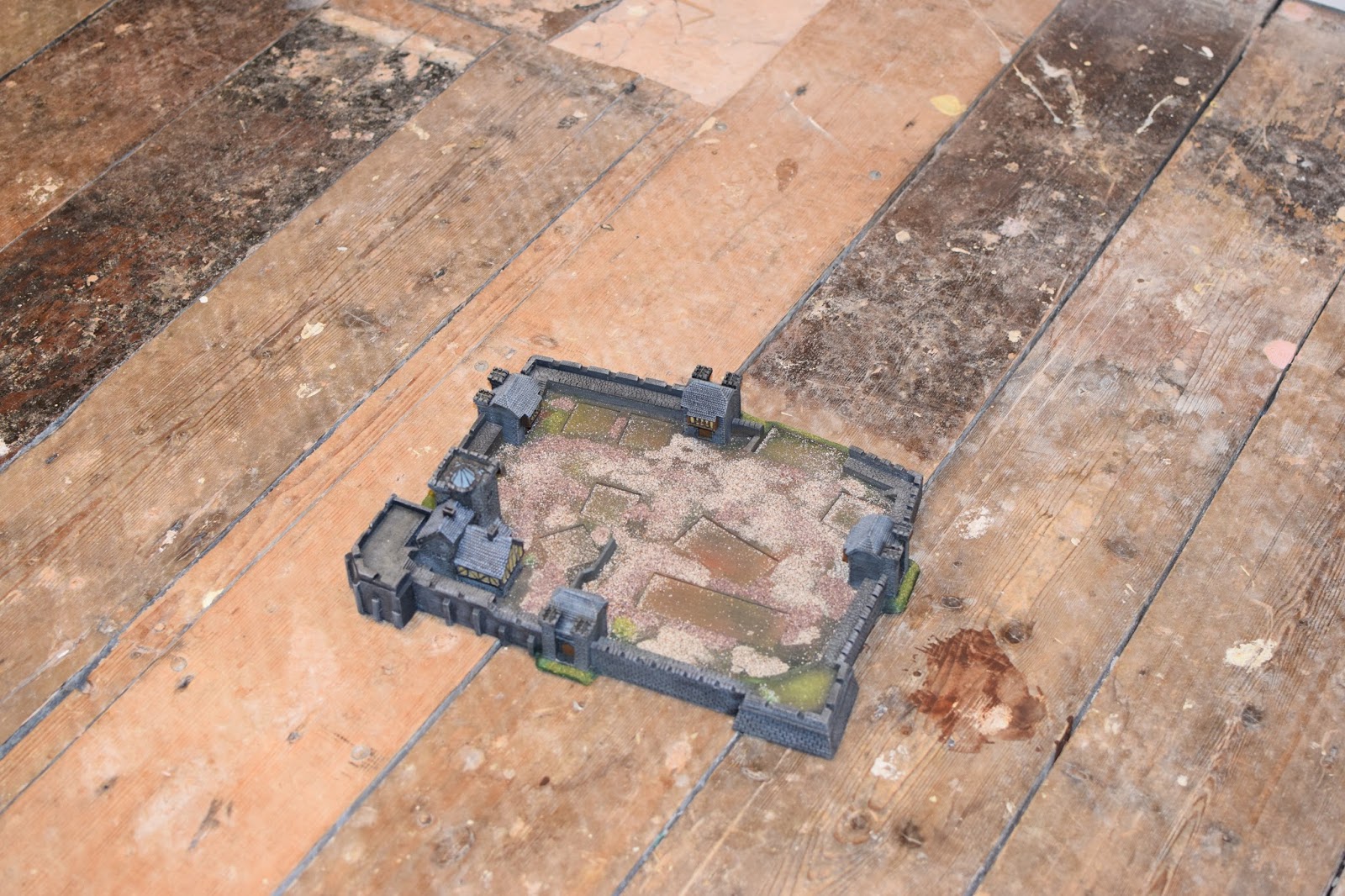
Finally finished - Marks TBM Medieval Town
Saturday, 16 January 2016
Their Finest Hour
Their Finest Hour
A WW2 Spearhead scenario written by Russ Fewtrell
Background
North Western France - October 1943
36 miles North West of Brest lies the small hamlet of Saint
Rennan . A detachment from the German 984th Grenadier regiment has been
deployed with re enforcements to defend a Flak 88 anti aircraft battery which
the Germans have deployed to defend Brest from RAF nigh time Bomber raids.
The battery has proved highly effective in defending Brest
from attacks over the North Western point of Brittany forcing the allied bomber
command to rethink it's flight plans and ultimately resigning to the fact that
higher casualties would be inflicted should the bombers have to fly around the
coast and into heavily defended axis flak fire.
As a result the allies have deployed a veteran battalion of
commandos armed with specialist explosives to infiltrate and knock out the flak
battery at Saint Rennan.
The scenario will take place during night time and turn 1
represents the arrival of the commandos from the small port of 'Le mole' some
23 miles West of Saint Rennan.
The allied player(s) objectives are to assault the Flak
battery and place explosives to destroy the guns. There are 3 88 Flak guns
deployed in the battery. To claim victory the British must of destroyed at
least 2 of the guns by the end of turn 12.
The German player(s) objectives is to successfully repel the
British assault. The Germans will claim a victory if they hold on to 2 guns or
by beating the British attack back.
British intelligence reports of possible German re enforcements
from nearby detachments of the 9th Panzer Division but there is uncertainty
about the accuracy of the intelligence.
The British will come on table from the Western edge. Night
time rules for spotting apply as follows:
Infantry in open - 3" extended to 6" if any stand
fires
Infantry in cover - no spotting extends to 6" if any
stand fires
Vehicles - as above but 6" and 12" if fired
Vehicles in cover 3" or 12" if fired
I'll e mail each of you the orders of battle shortly.......
Wednesday, 13 January 2016
War on the Eastern Front
I've started the mammoth task of redoing my WW2 Russians to provide troops for both winter and non-winter battles (in 6mm of course)!.
The first phase is done - with a division of German troops in winter camo already painted up and in the same numbers as the Russians below (4 men for standard infantry, 6 for SMG etc.)
Next phase I'm in at the moment - rebasing my 'summer' Russians. I've acquired these over a number of years from Ebay etc. and they are all on slightly different base sizes with different uniform colours, non-standard units per base (some with 8, 6, 3, 4 per stand plus vehicles etc.) and with different base depths (card, MDF) and flock - so basically they just looked a mess on the table.
So the big initial job has been taking them off their bases (never easy and a few casualties that had been excessively glued were incurred). This allows me to mix units up a bit more to make them look more interesting (so rather than just 4 infantry with the same pose I can mix it up with a grenade thrower, LMG, SMG, kneeling shooter etc.).
They will all be painted the same colour though and all base materials (talus, flock and paint colours) will be the same to give a much better overall look.
These will be based for Spearhead (3cm square bases) with 4 men per base for basic infantry, 6 for SMG, each heavy weapon will have its own base (81mm mortar, HMG etc.), engineers will be 4 to a base in a square formation (to differentiate from basic infantry) and all HQ units will have a small vehicle (scout car) plus 3 units. This will make units easier to identify. In addition, the rear edge of the base will have a different colour painted on it to provide easier identification of regiments.
This phase is well underway. I bought some more Russian infantry to ensure I had enough to fill the infantry requirements for any scenario and found I have many more SMG figures than I need so I will use one per base on standard infantry bases to meet the quotas. Some may find themselves fighting in Winter as a result (see below).
Phase 3 will then be vehicles - most of my tanks, AFV's etc. are well painted but as above come on many different bases. So this will be a simple case of just rebasing the vehicles themselves. However, with Winter war in mind, I must allocate essentially half of everything to have winter bases and winter camo.
Then Phase 4 is painting the Winter Russians. I've ordered a batch of basic infantry, SMG and heavy weapons from Heroics and Ros to meet the numbers required. These are fairly easy to paint up but winter basing is trickier so that's the bit which will take longest. Like their new Winter Germans, these are slightly chunkier but with better detail and more poses.
Final stage is then painting Winter German tanks and AFV's. I have a large number of vehicles acquired from Ebay over the years. Paint jobs on them are pretty poor and done for 'summer' campaigns. I need to basically strip the paint and start from scratch - and then base as per the winter infantry. I don't have summer Germans as Mark has everything we need.
In between times I have to put some thought to special rules for fighting in winter. Generally in Spearhead the Germans are basically much better than the opposition. Their infantry are better (+1) to account for their greater tactical nous and use of automatic weapons. They can change orders on anything but a 1 while Russians need a 6 to change orders for example - so the German commander can be much more flexible and change plans on a whim. Their vehicles also are better in terms of defence and attack.
However, in the Russian winter things were not as straightforward. Russian AFV's were better suited to the conditions (wider tracks on the tanks, better starters in the cold etc.). Russian troops were more comfortable in the cold and their hand held weapons were better (their lubricating oils meant that Russian guns rarely jammed in the cold - German guns often did). German troops were also disinclined to go on the offensive in the winter months.
This would probably be translated as ideas along the lines of...
a) German vehicles do not automatically start - they may need d4 or d6 turns to get started.
b) Once on the move, German vehicles roll a d6 each time they move and a 1 means they are stuck for that turn. If a 1 is rolled for the following turn it is stuck for the duration of the battle - it can still fire (if an AFV) or disembark troops (if and APC or truck).
c) Germans troops do not get their usual fighting bonus (the volume of firepower is offset by jammed weapons and cold fingers).
d) Before the battle starts the German player rolls against all troops and vehicles as if being hit by mortar or small-arms fire and suffers Supressions on a 'hit' - this represents poor unit cohesion, loss of troops through frostbite or cold-related conditions. Supressions are removed in the usual way. This may be optional after 1944 when better cold-weather uniforms were issued.
e) The referee can designate parts of the battlefield as 'deep snow' - areas in each sides zone of control are known by that player but not the opponent. Moving into these areas would slow or halt movement while inside them.
Some more ideas will come but that will do for now...
The first phase is done - with a division of German troops in winter camo already painted up and in the same numbers as the Russians below (4 men for standard infantry, 6 for SMG etc.)
Next phase I'm in at the moment - rebasing my 'summer' Russians. I've acquired these over a number of years from Ebay etc. and they are all on slightly different base sizes with different uniform colours, non-standard units per base (some with 8, 6, 3, 4 per stand plus vehicles etc.) and with different base depths (card, MDF) and flock - so basically they just looked a mess on the table.
So the big initial job has been taking them off their bases (never easy and a few casualties that had been excessively glued were incurred). This allows me to mix units up a bit more to make them look more interesting (so rather than just 4 infantry with the same pose I can mix it up with a grenade thrower, LMG, SMG, kneeling shooter etc.).
They will all be painted the same colour though and all base materials (talus, flock and paint colours) will be the same to give a much better overall look.
These will be based for Spearhead (3cm square bases) with 4 men per base for basic infantry, 6 for SMG, each heavy weapon will have its own base (81mm mortar, HMG etc.), engineers will be 4 to a base in a square formation (to differentiate from basic infantry) and all HQ units will have a small vehicle (scout car) plus 3 units. This will make units easier to identify. In addition, the rear edge of the base will have a different colour painted on it to provide easier identification of regiments.
This phase is well underway. I bought some more Russian infantry to ensure I had enough to fill the infantry requirements for any scenario and found I have many more SMG figures than I need so I will use one per base on standard infantry bases to meet the quotas. Some may find themselves fighting in Winter as a result (see below).
Phase 3 will then be vehicles - most of my tanks, AFV's etc. are well painted but as above come on many different bases. So this will be a simple case of just rebasing the vehicles themselves. However, with Winter war in mind, I must allocate essentially half of everything to have winter bases and winter camo.
Then Phase 4 is painting the Winter Russians. I've ordered a batch of basic infantry, SMG and heavy weapons from Heroics and Ros to meet the numbers required. These are fairly easy to paint up but winter basing is trickier so that's the bit which will take longest. Like their new Winter Germans, these are slightly chunkier but with better detail and more poses.
Final stage is then painting Winter German tanks and AFV's. I have a large number of vehicles acquired from Ebay over the years. Paint jobs on them are pretty poor and done for 'summer' campaigns. I need to basically strip the paint and start from scratch - and then base as per the winter infantry. I don't have summer Germans as Mark has everything we need.
In between times I have to put some thought to special rules for fighting in winter. Generally in Spearhead the Germans are basically much better than the opposition. Their infantry are better (+1) to account for their greater tactical nous and use of automatic weapons. They can change orders on anything but a 1 while Russians need a 6 to change orders for example - so the German commander can be much more flexible and change plans on a whim. Their vehicles also are better in terms of defence and attack.
However, in the Russian winter things were not as straightforward. Russian AFV's were better suited to the conditions (wider tracks on the tanks, better starters in the cold etc.). Russian troops were more comfortable in the cold and their hand held weapons were better (their lubricating oils meant that Russian guns rarely jammed in the cold - German guns often did). German troops were also disinclined to go on the offensive in the winter months.
This would probably be translated as ideas along the lines of...
a) German vehicles do not automatically start - they may need d4 or d6 turns to get started.
b) Once on the move, German vehicles roll a d6 each time they move and a 1 means they are stuck for that turn. If a 1 is rolled for the following turn it is stuck for the duration of the battle - it can still fire (if an AFV) or disembark troops (if and APC or truck).
c) Germans troops do not get their usual fighting bonus (the volume of firepower is offset by jammed weapons and cold fingers).
d) Before the battle starts the German player rolls against all troops and vehicles as if being hit by mortar or small-arms fire and suffers Supressions on a 'hit' - this represents poor unit cohesion, loss of troops through frostbite or cold-related conditions. Supressions are removed in the usual way. This may be optional after 1944 when better cold-weather uniforms were issued.
e) The referee can designate parts of the battlefield as 'deep snow' - areas in each sides zone of control are known by that player but not the opponent. Moving into these areas would slow or halt movement while inside them.
Some more ideas will come but that will do for now...
Friday, 8 January 2016
Joy Of Six 2016 - The Bridge At Remagen
Well folks it's time to decide on this Years JOS game and last night we had a chat about what was in the pipeline.
There have been a few games that keep on cropping up in conversation....
Pavia
peleliu
Tarawa
The Somme
I think we reached a conclusion last night and despite Pavia being the strong contender I personally feel that the terrain is a bit too much to take on.
The other games above (bar the Somme) have both been played before but are both "serious" battles and would require a fair amount of sprucing up if we were to go with one of these.
It just so happened out of coincidence we looked at Ian's Christmas game "The Bridge At Remagen"
and thought...... could we put this on at JOS?
Well the response was YES
The game itself was "fun" and the mechanics are already in place, a good starting point
There is a definite feeling that this would be the most unique game at the show - even better
It just has that "Novel" feel about it and you know that no one else will be pitching in the same spot.
I just need to know that Jon and Phil are okay with this decision (we voted last night)
If we are all on board then Ian will call a meeting to lay out the Project proper.
Falaise Pocket
Thursday nights game of spearhead .
scenario taken from Warning order online gaming magazine (cheers)
Germans had to gather their spread out forces and push the British blocking forces as British reinforcements arrived from random directions.
Tuesday, 5 January 2016
New H & R WW1 Germans
Just thought I would take a few snaps of my first packet of painted and based new sculpt H&R WW1 Germans....
The unit at the front with 4 figures represents my Stormtrooper company
The new poses are excellent and bring the figures to life
You get a full strip of command figures in each pack with a good assortment of poses,
for my HQ I have used a mix of figures with the binocular chap at the front, who will also come in handy as a FO on other stands.
As normal I asked for a second opinion on the base colour and the response from Debbi was "it looks like an alien planet"..... well for me that will do as I wanted to try and replicate the muddy battlefields of the Western Front on this army. I was reminded that the figures are still too small though.......
Bases are Coat'D Arms brushscape sand brown washed with GW sepia and the dry brushed Vallejo beige brown.
I sprayed the figures with the army painter matt spray which I am still not sure I like the finish.
Overall quite pleased with these and am looking forward to the next pack.
Battle of Como, Summer 1506
Imperial and French armies clash
The battlefield was constrained by steep hills, closely cultivated slopes and stoutly built villages that reflected this part of Northern Italy that bordered Lake Como and the Alps beyond.

The French command had decided to cautiously await the Imperial advance against Como before releasing their heavy cavalry against an enemy that they hoped would be divided by the terrain. However, there plans seemed misplaced as the Imperials adopted a position covered by high terrain and appeared to await the imminent arrival of the Duke of Milan which would give them an overwhelming advantage against the French. The French, therefore, felt they had to bring the battle to the Imperials before the Duke could tip the balance against them.
The French commander took the bulk of the Gensd'armes on a wide outflanking manoeuvre on the right whilst the rest of the army moved forward to pin the Imperials. To the surprise of the French, the Imperial commander had chosen not to wait for the Duke and hoped that a sudden attack would upset any French calculations; it did!
As Imperial knights struggled dangerously through narrow defiles, the few French Gensd'armes on the left flank were hamstrung by their initial orders and failed to contain the Imperial advance. Brushing aside the limited opposition, the Imperial commander was close to taking the French baggage. Meanwhile the French commander was appraised of the developing situation and was slowly able to reorder his mass of cavalry towards the baggage and support his centre. The inferior French Pike in the centre was doing its best the hold the Imperials but a desperate charge by the compromised French left temporarily shut the door on further Imperial reinforcements and slowed the attack against the baggage.
Now the French commander and the van made their influence felt and the Imperial attack stalled amidst the French pike and reinvigorated French left. Imperial knights were beginning to route off the field and it seemed the crisis point of the battle had been reached . The French commander urged on his command to crush the Imperials and the French pike reformed and advanced in support; the French were now confident of victory.
However, the Imperial commander still had his uncommitted centre made up of veteran lansknechts and supporting arquebusiers. These moved forward through the fleeing knights and opened a withering fire upon the advancing French. Daunted by the covering pike the French were now more cautious and opted to await night and better opportunities in the morning against their half beaten foe.
As expected the Duke arrived during the night with his badly needed reinforcement of Milanese knights. The Imperial commander had been dismayed at the failure of his attack and the many casualties his knights had suffered. He advised a retreat onto Milan but the Duke was determined to continue the battle. He argued that his command amply covered Imperial losses and that many of the routers were returning the to their colours. The commander of the pike also made it clear that his men were still fresh and willing to fight. Heartened, the Imperial commander agreed to continue the battle but chose a plan that kept his cavalry massed and in reserve whilst deploying his infantry to make the most of the difficult terrain.
Early the next morning, the French resumed their attack on what they considered to be the demoralised and weakened Imperial right. Once more, the French commander advanced against the Imperial left in an attempt to pin the mass of Imperial and Milanese cavalry on that flank.
As the French left advanced, the supporting centre once more came under a deadly arquebus and light artillery fire. French infantry began to route, and as gunners ran from their cannon the pike also began to collapse. Spurred on to bring the battle to a close, the Gensd'armes of the left charged the arquebusiers in difficult terrain and boldly advanced against a contingent of Imperial knights that they recognised as the defeated remnants of the force that they had routed the previous day.
However, the Imperial commander had fully recovered his composure and in a cunning display of tactics, he manoeuvred his lansknechts into a position that blocked the French but forced them onto their pikes. The weak Imperial knights had been placed as a lure and the French had taken the bait. Simultaneously, the arquebusiers had been able to inflict considerable damage upon the French before retiring in the difficult terrain or behind the protective pike.

Again, a tipping point had been reached and the French were quick to see that it was not in their favour. On the far right, the French commander had been easily contained and was now aware of the disadvantage of his inferior numbers. The French centre was disintegrating purely from Imperial firepower and the French left struggled not to impale itself on the lansknechts whilst taking fire from enemy skirmishers.
Dismayed, the French commander elected to save his army and retire off the battlefield. Yet, the French struggled to extricate themselves from the superior pursuing Imperial light cavalry and the army was considerably weakened by the time it reached Turin, having to abandon much equipment and valuable artillery in its retreat.
Commentators were quick to see the Imperial use of combined pike and arquebusier as a decisive development in the art of war, although many advocates for the superiority of the armoured horseman argued that the terrain mitigated against French success. Nevertheless, the Duke and Emperor were delighted by this famous victory and now looked to see what advantages could be seized, and what vengeance could be wrought!
Subscribe to:
Posts (Atom)


